
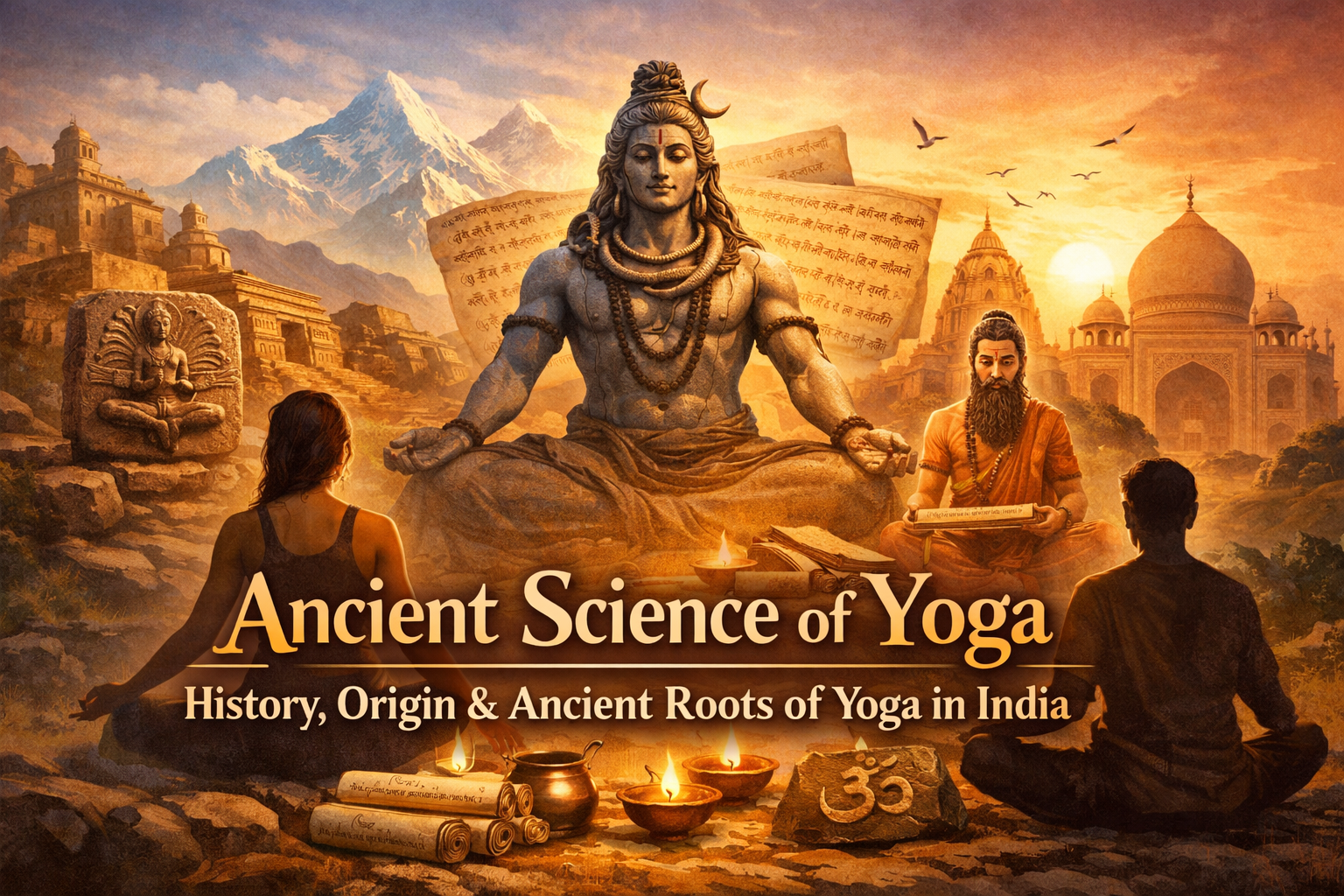
Ancient Science of Yoga: History, Origin, and Ancient Roots of Yoga in India
The ancient science of yoga is one of humanity’s greatest contributions to physical health, mental clarity, and spiritual evolution. Rooted deeply in the history of yoga, this sacred discipline has evolved over thousands of years, influencing civilizations, philosophies, and modern wellness practices across the world. To truly understand yoga, we must explore its ancient history, its philosophical foundation, and answer the common question: Yoga originated from which country?
The clear and historically supported answer is India—the birthplace and spiritual home of yoga.
What Is the Ancient Science of Yoga?
Yoga is not merely a physical exercise system. It is an ancient science designed to harmonize the body, mind, breath, and consciousness. The word Yoga comes from the Sanskrit root “Yuj”, meaning to unite or join. This union refers to the integration of individual consciousness with universal consciousness.
In ancient Indian traditions, yoga was considered a systematic science of self-realization, practiced by sages to attain higher awareness, inner peace, and liberation (moksha).
Origin of Yoga in India
Yoga Originated from Which Country?
Yoga originated from India, a fact supported by archaeological evidence, ancient scriptures, and continuous cultural practice. India has preserved yoga as a living tradition for over 5,000 years.
The origin of yoga in India can be traced back to:
- The Indus Valley Civilization (circa 3000 BCE)
- The Vedic period
- The Upanishadic era
- Classical texts like the Yoga Sutras of Patanjali
Ancient seals discovered in the Indus Valley depict figures seated in yogic postures, suggesting that yoga was practiced even before written history.
Ancient History of Yoga
Pre-Vedic and Indus Valley Roots
The ancient history of yoga begins long before written scriptures. Archaeologists discovered seals in Mohenjo-Daro showing a meditative figure resembling Lord Shiva as Pashupati, considered the first yogi (Adi Yogi).
These findings suggest that yoga was originally a spiritual and meditative practice, not a fitness routine.
Yoga in the Vedic Period
The Vedas (Rigveda, Yajurveda, Samaveda, Atharvaveda) are the oldest known sacred texts of India. While yoga was not systematically defined during this era, its foundational concepts were present.
Key yogic ideas in the Vedic age include:
- Meditation (Dhyana)
- Breath control (Pranayama)
- Ritual discipline
- Cosmic unity
The Rigveda emphasizes inner awareness and disciplined living, which later became central to yoga philosophy.
Upanishads and the Philosophical Evolution of Yoga
The Upanishads refined the spiritual dimensions of yoga. These texts focus on:
- Self-inquiry
- Meditation
- The relationship between Atman (soul) and Brahman (universal consciousness)
Important yogic teachings emerged here, including pratyahara (withdrawal of senses) and deep meditative states.
This period firmly established yoga as a path to enlightenment, not just physical wellbeing.
Classical Yoga and Patanjali’s Yoga Sutras
One of the most influential milestones in the history of yoga is the Yoga Sutras of Patanjali (circa 200 BCE – 400 CE).
Patanjali systemized yoga into the Eightfold Path (Ashtanga Yoga):
- Yama (ethical restraints)
- Niyama (personal discipline)
- Asana (posture)
- Pranayama (breath control)
- Pratyahara (withdrawal of senses)
- Dharana (concentration)
- Dhyana (meditation)
- Samadhi (liberation)
This text transformed yoga into a structured scientific discipline, making it accessible and teachable.
Hatha Yoga and Medieval Yoga Traditions
Between the 9th and 15th centuries, yoga evolved further with the emergence of Hatha Yoga.
Key texts include:
- Hatha Yoga Pradipika
- Gheranda Samhita
- Shiva Samhita
This era introduced:
- Physical postures (asanas)
- Energy channels (nadis)
- Chakras
- Kundalini awakening
Hatha Yoga aimed to prepare the body for higher meditation by cleansing and strengthening it.
Yoga as a Holistic Science
The ancient science of yoga integrates multiple dimensions of human existence:
- Physical: Strength, flexibility, immunity
- Mental: Focus, emotional balance
- Energetic: Prana flow, chakra alignment
- Spiritual: Self-realization, inner peace
This holistic approach makes yoga timeless and universally relevant.
How Yoga Spread Globally
Yoga remained largely within India until the late 19th and early 20th centuries.
Key figures who introduced yoga to the world:
- Swami Vivekananda
- Paramahansa Yogananda
- B.K.S. Iyengar
- T. Krishnamacharya
- Pattabhi Jois
Today, yoga is practiced in over 190 countries, yet its roots remain deeply Indian.
Why India Is the Spiritual Home of Yoga
Despite its global popularity, India remains the authentic source of yoga because:
- Ancient scriptures originated in India
- Continuous lineage of teachers exists
- Sacred geography (Himalayas, Rishikesh)
- Integration with Ayurveda and meditation
Places like Rishikesh, known as the Yoga Capital of the World, preserve yoga’s traditional essence.
Modern Yoga vs Ancient Yoga
| Ancient Yoga | Modern Yoga |
|---|---|
| Spiritual liberation | Fitness & wellness |
| Meditation-focused | Asana-focused |
| Guru-disciple tradition | Studio-based |
| Lifestyle philosophy | Exercise routine |
Both forms are valuable, but understanding ancient roots adds depth and authenticity.
Importance of Understanding the History of Yoga
Knowing the history and origin of yoga in India helps practitioners:
- Practice with respect and awareness
- Avoid commercial dilution
- Connect yoga to its spiritual purpose
- Experience deeper transformation
Yoga is not a trend—it is a living ancient science.
People Also Ask (FAQs)
- What is the ancient science of yoga?
The ancient science of yoga is a holistic system from India designed to unite body, mind, and soul through ethical living, postures, breathwork, and meditation.
- Where did yoga originate?
Yoga originated in India, over 5,000 years ago.
- What is the history of yoga?
The history of yoga spans from the Indus Valley Civilization through the Vedic, Upanishadic, Classical, and Hatha Yoga periods to modern times.
- Is yoga a religion?
No, yoga is not a religion. It is a spiritual science and philosophical system that complements all belief systems.
- Who is considered the founder of yoga?
There is no single founder, but Patanjali is credited with systemizing yoga through the Yoga Sutras.
- What are the oldest yoga texts?
The Vedas, Upanishads, Bhagavad Gita, and Yoga Sutras are among the oldest yoga texts.
- Why is India called the birthplace of yoga?
Because all foundational yoga philosophies, texts, and practices originated and evolved in India.
- How old is yoga?
Yoga is over 5,000 years old, based on archaeological and textual evidence.
- What is the goal of ancient yoga?
The ultimate goal is self-realization and liberation (moksha).
- How is ancient yoga different from modern yoga?
Ancient yoga emphasizes spiritual growth and meditation, while modern yoga often focuses on physical fitness.
I’m here in a7xcasino playing for now. Wish me luck so that I can get the big win! I hope I can share it on my social media account so people will have trust on this!. Check them out: a7xcasino
Okay, Okiebetapp is pretty solid for betting on the go. Easy to use, and they got odds I can appreciate. Might be worth a download if you want a quick gamble. Look here okiebetapp.
888winlogin? Nice site, nice bonuses, nice everything! Check it out, it’s my favourite one 888winlogin.